Refractory Brick Mold
After years of research, we gathered a good knowledge of Vacuum Welding between carbide and steel in a relatively big area, we know how to release the Inner stress of Welding to improve the Welding Quality.
This fire brick mold is a new type of Heat-resisting brick mold, that adopted vacuum welding between carbide and steel technology. Currently, we use adhesive technology to connect the carbide part and steel part, while the carbide is easy to get off from the steel after several times making goods. One set mold for making tricks should be used for 50000times, which would waste much time to make face milling grinding for the mold. Our new mold technology solves this problem perfectly.
The advantages of Vacuum welding carbide and steel die
The combination of carbide and steel material, meet the feature of molds, such as wear resistance, heat resistance, and strength requirements, as well as long life. As a part of the mold, steel saves production cost-effectively.
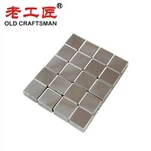
The refractory brick carbide composite mold consists of upper and lower plates, two side plates, and two head plates. Each plate is fixed on the carbon steel plate or alloy tool steel plate by a small piece of spliced carbide plate composite layer (welding layer or bonding layer). The die plate can be made into a tip shape, in which the cemented carbide is welded to the steel plate by small trapezoidal and diamond blocks, and the carbon steel plate is a tip-shaped plate. Its advantages are good wear resistance, and its service life is 5 times longer than that of the existing mold, which can improve the utilization rate of the equipment, and is easy to replace, thereby reducing production costs.

The refractory brick cemented carbide composite mold is composed of three groups of six molds, namely, two side plates and two head plates of the upper and lower plates.
At present, the molds used in the production of refractory bricks are made of carbon steel or alloy tool steel by carburizing and quenching. The disadvantage is that the strength is low and the service life is short. Generally, about 800-1200 pcs of refractory bricks are produced, which need to be replaced and maintained, which affects the utilization rate of equipment and thus increases the production cost. The current refractory brick mold is designed for existing refractory bricks The defects of the brick mold are improved to provide a refractory brick with high strength and long service life. The purpose of the cemented carbide composite mold is to change the existing single-layer carbon steel or alloy tool steel refractory brick mold into a cemented carbide composite mold, the specific structure is: the outer layer-non-working surface is carbon steel plate or alloy tool steel plate, and the inner layer-working surface is cemented carbide spliced by small pieces of cemented carbide.