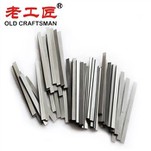
Hard alloy bushing is a kind of alloy material made of hard compound of refractory metal and bonding metal by powder metallurgy process. Hard alloy has a series of excellent properties such as high hardness, wear resistance, good strength and toughness, heat resistance, corrosion resistance, especially its high hardness and wear resistance, even at the temperature of 500℃ is basically unchanged, at 1000℃ still has a high hardness. Hard alloy is widely used as tool materials, such as turning tool, milling cutter, plane cutter, drill, boring tool, etc., for cutting cast iron, non-ferrous metals, plastics, chemical fiber, graphite, glass, stone and ordinary steel, can also be used to cut heat-resistant steel, stainless steel, high manganese steel, tool steel and other difficult materials. New carbide tools can now cut hundreds of times faster than carbon steel.
Introduction of hard alloy bushing:
- Adopt advanced molding technology, can produce a variety of complex shapes of cemented carbide products; Can organize production according to user's drawing.
- Small deformation, very high precision.
- No machining or minimal machining required.
With the increase of oil extraction, the oil on the shallow surface decreases. In order to ensure the use of oil, people gradually develop to large deep Wells and high-inclination Wells, but the difficulty of oil exploitation gradually increases. Therefore, the parts of oil exploitation are required to have good wear resistance, corrosion resistance or impact resistance.
As a wear-resistant part in petroleum machinery well, hard alloy bushing has high hardness, good wear resistance and high finish performance. It has been applied more and more widely in modern society to meet the needs of daily use and special performance. Some enterprises adopt spray welding technology to improve the durability and service life of cemented carbide bushing.
After spraying welding, the hardness of cemented carbide bushing can reach HRC60 and the wear resistance is better, which can meet the requirements of the petroleum machinery industry. However, the cemented carbide bushing after spraying welding needs to be turned, so as to ensure the size requirements and precision requirements of the drawings.
At present, the common tool materials are hard alloy tool, ceramic tool and cubic boron nitride tool, but from the hardness of hard alloy bushing can exclude hard alloy tool, ceramic tool although suitable for processing high hardness workpiece, but only suitable for small amount of finishing process. Therefore, the most suitable tool material for processing carbide bushing is cubic boron nitride tool.