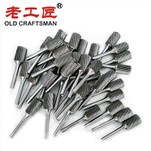
Tungsten carbide is used in many industries because of its superior hardness characteristics compared to tool steel and superior toughness compared to technical ceramics. Given these superior properties, tungsten carbide is most commonly associated with tools used in metal cutting applications, such as sawing, milling and turning. Many people are surprised to learn that tungsten carbide is also often used in fluid dispensing or flow applications because of its excellent service life when exposed to erosive wear. The improved wear resistance of tungsten carbide extends the component life of items such as nozzles in the water jet cutting, oil and gas, and electronics industries. While the benefits of tungsten carbide are well known to many of the engineers who design these parts, the challenges of making them are less well known.
First, it should be explained that tungsten carbide is the name used for a broad class of alloys consisting of actual tungsten carbide as well as metal binders and other added carbides (i.e. TiC and TaC). The two most common metal binders are cobalt and nickel. Metal binders affect hardness, toughness and chemical compatibility. The metal binder content may vary from 3-20% of the finished material, depending on the desired properties.
Instant pressed powder is made by mixing tungsten carbide (WC) powder, metal binder, and organic binder in a solvent and then evaporating the solvent from the mixture using a spray drying process. The powder is then compacted in a press to create a green section that is roughly as strong as a piece of chalk. Although raw parts are brittle, they can be machined using traditional turning, milling and drilling techniques. Care must be taken when calculating the geometry, as the green parts shrink by up to 20% during sintering. In addition, the temperature during the sintering process (2500-2700oF) as the metal adhesive melts, the parts become relatively soft and areas of thin wall thickness may collapse. When removed from the sintering process, the part is in a hardened state. In addition, precise features cannot be created during the green forming process due to shrinkage, which means that complex and precise geometric features must be added to the hardened part after sintering.
Unlike steel components, tungsten carbide cannot be routinely turned, drilled, milling or welded in its hardened state. Instead, we are left with grinding and EDM processes that are time-consuming, expensive, and have limited ability to create certain geometrics.
This is where binder injection and additive technologies such as FDM can add value to customers by creating geometries previously unavailable in tungsten carbide. While there are challenges in making powders suitable for printing, progress is being made to bring the additive advantages that the hard materials world is known for.
One example is the screw pump rotor (Moineau principle), whose geometry cannot be formed in a green part or ground in a finished part. With additive technology, pump designers can resist abrasive wear when pumping challenging liquids, thus having another material in their Arsenal.
Another example is the creation of an all-in-one nozzle or spreader for fluid dispensing, where a curved fluid path is preferred. Just a few years ago, these geometry shapes were considered impossible to achieve in tungsten carbide, so engineers were left with second-best materials or less efficient geometry, both of which imposed ongoing maintenance costs on the customer.