The production process of carbide cutting tools:
Production material
The production of cemented carbide tools generally requires the preparation of tungsten carbide, titanium carbide, niobium carbide and metal cobalt powder.
Process flow
The tungsten carbide and cobalt are prepared in the required proportions, then alcohol is added and ball milled. After ball milling, it is dried, sieved, added with molding agent, then dried, smashed and sieved to obtain the desired mixture, which is then sent to be pressed. Duck products are sintered to become the final product.
Carbide tool performance:
Cemented carbide has a series of excellent properties such as high hardness, wear resistance, good strength and toughness, heat resistance and corrosion resistance, especially its high hardness and wear resistance, which remain basically unchanged even at a temperature of 500 °C , still has high hardness at 1000 ℃.
Hardness
The hardness of cemented carbide is generally between HRA86~93, and decreases with the increase of cobalt content in the alloy. In tungsten-titanium-cobalt alloy, the hardness of cemented carbide increases with the increase of titanium carbide content. Therefore, when the cobalt content is the same, the hardness of tungsten-titanium-cobalt alloy is higher than that of tungsten-cobalt alloy.
Flexural strength
At room temperature, the flexural strength of cemented carbide is between 75~250kg/mm2, and the higher the cobalt content, the higher the flexural strength. When the cobalt content is constant, the increase of titanium carbide content causes resistance The bending strength drops sharply. The surface condition of cemented carbide has a great influence on its flexural strength. When manufacturing cemented carbide tools, various cracks should be prevented from occurring on the surface.
Impact toughness
Cemented carbide is highly brittle and almost independent of temperature. At room temperature, the impact toughness of quenched steel is 1 to 2 times greater than that of cemented carbide, while that of annealed steel is 9 times greater than that of cemented carbide. Therefore, when inserting and welding cemented carbide cutting tools, impact compression of cemented carbide blades is not allowed. When transporting carbide tools, care should be taken not to collide with each other or be impacted, otherwise damage will occur.
Abrasion resistance
The wear resistance of cemented carbide is 15-20 times higher than that of the best high-speed steel. The wear resistance of cemented carbide is particularly significant when the tool is worn in metal cutting.
Compressive strength
The compressive strength of cemented carbide is related to the cobalt content in the alloy and the grain size of tungsten carbide; the compressive strength of tungsten-cobalt alloy increases with the increase of cobalt content, and the compressive strength value is the largest when the cobalt content is 5%, and the cobalt content continues The compressive strength of the fine-grained tungsten-cobalt alloy is also higher than that of the coarse-grained tungsten-cobalt alloy, and the compressive strength of the tungsten-titanium-cobalt alloy is lower than that of the tungsten-cobalt alloy.
Thermal conductivity
The heat generated in metal cutting is mainly conducted on the tool, cutting and machined parts. When the thermal conductivity of the tool is very high, most of the heat is transferred to the tool, and a very small part is transferred to the cutting and machined parts. When the thermal conductivity of the tool is very low, on the contrary, the heat is mostly concentrated on the chip, which is beneficial for chip machining. Because the chips are softened by intense heat. The thermal conductivity of tungsten-cobalt alloy is 1-2 times higher than that of high-speed steel. The thermal conductivity of high titanium alloy is lower than that of high speed steel.
Coefficient of linear expansion
The coefficient of linear expansion of tungsten-cobalt alloy is small, lower than that of high-speed steel, carbon steel and copper, and increases with the increase of cobalt content; the coefficient of linear expansion of tungsten-titanium-cobalt alloy is higher than that of tungsten-cobalt alloy, and It increases slightly with the increase of titanium carbide content, but its linear expansion coefficient is still much smaller than that of high-speed steel.
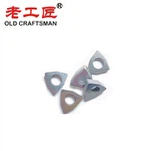
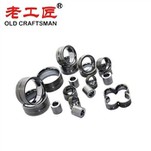
The Carbide Cutting Tools manufactured by ZZ Old Craftsman have different specifications and applications. For examples:


Carbide Blade for 5-axis machining centre Carbide Bar/ Plate for Cutting


Tungsten Carbide Woodworking Inserts Cemented Carbide Profile Inserts