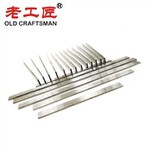
Formed carbide milling cutters are widely used because of their small shape tolerances. Because the blade can not be replaced directly, most of the milling cutter is scrapped after the blade collapses, which greatly increases the processing cost. Next, carbide tool manufacturers for you to analyze the causes of carbide tool edge wear.
1, the characteristics of processing materials
When cutting titanium alloy, due to the poor thermal conductivity of titanium alloy, chips are easy to bond or form chip tumors near the edge of the tool tip, and form a high temperature area near the front and back of the tool tip, so that the tool red hard loss and wear increase. In high temperature continuous cutting, the adhesive and fusion will be affected by the subsequent processing, in the process of forced washing, will take away part of the tool material, resulting in tool defects and damage. In addition, when the cutting temperature reaches more than 600 ° C, the surface of the parts will form a hardened hard layer, which has a strong wear effect on the knife. Titanium alloy has low elastic modulus, large elastic deformation, and large surface rebound near the back tool face, so the contact area between the machining surface and the back tool face is large, and the wear is serious.
2, normal wear
In normal production and processing, when the margin of continuous milling titanium alloy parts reaches 15mm-20mm, there will be serious blade wear. Continuous milling efficiency is very low, the workpiece surface finish is very poor, can not meet the production and quality requirements.
3. Improper operation
During the production and processing of titanium alloy castings such as box covers, improper clamping, inappropriate cutting depth, excessive spindle speed, insufficient cooling and other improper operations will lead to tool collapse, damage, and break. In addition to being unable to effectively mill, this defect cutter will also cause defects such as concave machining surface due to "nibbling" in the milling process, which not only affects the machining quality of the milling surface, but also leads to workpiece waste.
4. Chemical wear
At a certain temperature, the tool material reacts chemically with some of the surrounding media, forming a layer of compounds with lower hardness on the surface of the tool, and the chips or workpieces are wiped off to form wear and chemical wear.
5, phase change wear
When the cutting temperature reaches or exceeds the phase change temperature of the tool material, the microstructure of the tool material will change, the hardness will decrease significantly, and the resulting tool wear is called phase change wear.