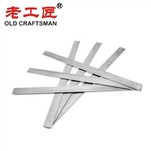
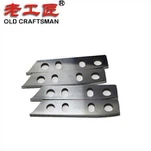
Carbide welding blade is also called carbide welding cutter head, or carbide cutter, is one of the commonly used carbide blade product categories in the manufacturing industry, product grade classification is wide, product model classification is more, depending on the specific use requirements. Carbide welding blade is welded to the blade part and the cutter body part of the connection, through the dehydration of borax, copper, ferro manganese, glass powder and other solder, through high temperature melting, so that alloy, high-speed steel, cubic boron nitride, diamond, ceramic and other materials of the blade and the groove of the same tool stick together, in order to meet the requirements of machining operations.
Nine points of use of carbide welding blades:
1, welding cutting tool structure should have enough rigidity
Sufficient rigidity is ensured by the maximum allowable contour size and the use of high strength steel grades and heat treatment.
2, carbide blade should be fixed firmly
The cemented carbide welding blade should have enough fixed firmness, which is guaranteed by the groove and welding quality, so the insert shape of the blade should be selected according to the shape of the blade and the geometric parameters of the tool.
3, carefully check the knife rod.
Before welding the blade to the tool bar, it is necessary to check the blade and the tool bar, and first of all, the support surface of the blade should not be seriously bent. The cemented carbide welding surface shall not have a serious carburizing layer, and the dirt on the surface of the cemented carbide blade and the insert of the tool bar should also be removed to ensure that the welding is solid.
4, reasonable selection of solder
In order to ensure welding strength, the appropriate solder should be selected. In the welding process, good wettability and fluidity should be ensured, and bubbles should be excluded, so that the welding and alloy welding surface are fully in contact, without welding phenomenon.
5, the correct choice of welding flux
It is recommended to use industrial borax, which should be dehydrated in the drying furnace before use, then crushed, screened to remove mechanical debris, and then used.
6, choose mesh compensation gasket
When welding high titanium and low cobalt fine particle alloys and long and thin alloy blades, in order to reduce welding stress, it is recommended to use thin sheets with thickness of 0.2-0.5mm or mesh compensation gaskets with mesh aperture of 2-3mm for welding.
7, the correct use of grinding method
Because the carbide blade is brittle and sensitive to crack formation, the tool should avoid overheating or quenching in the grinding process, and at the same time, the grinding wheel with appropriate particle size and reasonable grinding process should be selected to avoid grinding cracks and affect the service life of the tool.
8. Install the tool correctly
When installing the tool, the length of the tool head extending out of the tool holder should be as small as possible, otherwise, it is easy to cause tool vibration, thus damaging the alloy sheet.
9. Regrind and grind the tool correctly
When the tool is used to reach normal blunting, it must be re-ground. After re-grinding the tool, it is necessary to grind the cutting edge and the rounded corner of the tool with a whetstone, which will improve the service life and safety and reliability of the tool.