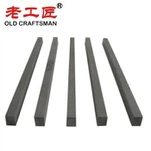
Cemented carbide is produced by powder metallurgy and is a composite material composed of high-temperature refractory metal compounds (such as WC, TiC, TaC, NbC, VC and TiN, etc.) and bonding metals (Co, Ni, Mo, Fe, etc.) . The inventor of modern cemented carbide is Schrotter of Geotechnical Engineering. He first proposed the production of cemented carbide by powder metallurgy in 1923. The technology in his patent is still in the production of WC-Co cemented carbide. application in the process. In 1926, Germany's Krupp company began industrial production of cemented carbide.
Cemented carbide has extremely high hardness, wear resistance and thermohardness, and is a very important wear-resistant material in modern industry. With the rapid development of modern manufacturing industry, cemented carbide has been widely used in all walks of life.
Cemented carbide is mainly used in metal cutting tools, mining, coal mining picks, rock drilling, oil drilling, geological exploration tools, stretching, extrusion, stamping dies, construction drilling tools, woodworking tools, environmental protection tools, rolls , roller rings and measuring tools, as well as spraying, brazing and spraying of friction surfaces of various wear-resistant mechanical parts. In addition to being used as tool materials and wear-resistant materials, cemented carbide also has important applications in high temperature resistance and corrosion resistance.
The main characteristics of cemented carbide are:
1) High hardness and wear resistance, especially excellent red hardness: at 600°C (837K), the hardness is higher than that of high-speed steel at room temperature, and at 1000°C (1273K), the hardness is higher than that of carbon steel Room temperature hardness.
2) It has a high elastic modulus, generally (4-7) x104 MPa.
3) High compressive strength, up to 600MPa
4) It has low impact toughness and plasticity.
5) Has a low expansion coefficient: (4.5-7)x10-6 K-1
6) Thermal conductivity and electrical conductivity are close to those of cast iron
7) It has relatively stable chemical properties. Some grades of cemented carbide have acid resistance, alkali resistance, and high temperature oxidation resistance.
Because cemented carbide is relatively expensive, its plasticity and impact toughness are poor, so most of the application forms of cemented carbide are made of small pieces of cemented carbide as inserts, which are attached to high-strength steel such as structural steel and tool steel. The working part of the part; and the high-strength steel is used to bear the impact load, which saves the expensive cemented carbide and reduces the manufacturing cost. The commonly used methods of connecting cemented carbide and steel are: brazing method, mechanical clamping method, stress inserting method and bonding method. Brazing is the most widely used and one of the most successful methods for firmly joining cemented carbide to the steel base metal.
For the introduction of brazing of carbide products, please check: https://www.zzcarbidebrazed.com/customized-service