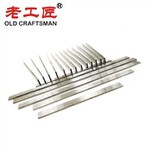
The basic knowledge of carbide tool includes tool structure, tool Angle reference, tool Angle, tool clamping, working part, etc.
Angular reference frame
Cutting plane ---- The plane tangent to the cutting edge and perpendicular to the base plane through the selected point of the cutting edge.
Main cutting plane Ps---- The plane tangent to the main cutting edge and perpendicular to the base plane through the selected point of the cutting edge. It is tangent to the transition surface, that is to say it is a plane composed of cutting speed and cutting edge tangents.
Secondary cutting plane ---- The plane tangent to the secondary cutting edge and perpendicular to the base plane through the selected point of the cutting edge.
Base Pt---- The plane perpendicular to the direction of the resultant cutting velocity through the selected point of the cutting edge. In the tool static reference system, it is the plane of the selected point of the cutting edge, parallel or perpendicular to the tool in manufacturing, grinding and measurement is suitable for installation or positioning of a plane or axis, generally speaking, its orientation should be perpendicular to the assumed direction of the main motion.
Assume that the working plane ---- is in the tool static reference system, it is the selected point of the cutting edge and perpendicular to the base plane, generally speaking, its bearing should be parallel to the assumed main direction of motion.
Normal plane Pn---- The plane perpendicular to the selected point through the cutting edge.
Tool Angle
Fore Angle ---- The Angle between the front and the base.
Back Angle ---- The Angle between the back and the cutting plane.
---- The Angle between the front and the back.
Principal declination ---- The Angle between the principal cutting plane and the assumed working plane, measured in the base plane.
Auxiliary declination ---- The Angle between the auxiliary cutting plane and the assumed working plane, measured in the base plane.
Tool tip ---- The Angle between the primary cutting plane and the secondary cutting plane, measured in the base plane.
Edge Angle ---- The Angle between the main cutting edge and the base surface, measured in the main cutting plane.
Clamping part
There are two kinds with holes and handles. The tool with hole depends on the inner hole set in the spindle or spindle of the machine tool, with the help of the axial key or the end key to transfer torsional torque, such as cylindrical milling cutter, sleeve type face milling cutter, etc.
Tools with handles usually have rectangular handles, cylindrical handles and conical handles. Turning tool, plane tool, etc., generally rectangular handle; The taper handle withstands axial thrust and transmits torque with the help of friction. Cylindrical shank is generally suitable for smaller twist drill, end milling cutter and other tools, cutting with the friction generated when clamping torque transfer. The shank of many tools with handles is made of low alloy steel, and the working part is welded together with high speed steel.
Working part
It is the part of generating and processing chips, including the blade, the structure of making chips broken or rolled up, the space for removing chips or storing chips, the channel of cutting fluid and other structural elements. Some of the working part of the cutting tool is the cutting part, such as turning tool, planing tool, boring tool and milling cutter; The working part of some tools, such as drill, reaming drill, reamer, inner surface broach and tap, includes cutting part and calibration part. The role of the cutting section is to remove the chip with the blade, and the role of the calibration section is to polish the cut surface and guide the tool.
The structure of the working part of the tool has three kinds: integral, welding and mechanical clamping:
The overall structure is to make cutting edge on the tool body;
The welding structure is to braze the blade to the steel cutter body;
There are two kinds of mechanical clamping structure, one is to clamp the blade on the tool body, the other is to clamp the brazed tool head on the tool body.
Carbide tool is generally made of welding structure or mechanical clamped structure; Porcelain cutting tools are mechanically clamped structure.
The geometric parameters of cutting parts have great influence on cutting efficiency and machining quality. The increase of the front Angle can reduce the plastic deformation of the cutting layer when the front cutting surface is squeezed, reduce the friction resistance of the chip flowing through the front, and thus reduce the cutting force and cutting heat. But increasing the front Angle will reduce the intensity of the cutting edge and reduce the heat dissipation volume of the cutting head.
In the choice of tool Angle, need to consider the influence of a variety of factors, such as workpiece material, tool material, processing properties (rough, finish), must be reasonable choice according to the specific situation. Generally speaking, the Angle of the tool, refers to the manufacturing and measurement of the mark Angle in the actual work, because of the installation position of the tool and the change of the direction of cutting motion, the actual working Angle and the mark Angle is different, but usually very small difference.