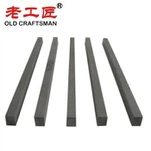
Refractory product mold refers to a model for forming refractory bricks. The shape and geometric dimensions of the mold are designed according to the shape of the product, and its structure is composed of a mold frame, a backing plate and a template. The template bears the molding pressure exerted by the brick press, so that a large friction force is generated between the brick material and the template. Therefore, the surface of the template is easy to wear. Generally, it is not allowed to continue to be used when the wear reaches 0.3-0.4mm. Therefore, the template is required to have good wear resistance. The materials of the template include carbon inscription, high chromium alloy steel, high chromium cast iron, hard alloy and steel Cemented carbide, etc.
Carbon steel template for the refractory brick mold
Use low and medium carbon steel to infiltrate carbon and nitrogen into the surface at the same time through gas carbon-nitrogen co-infiltration heat treatment to improve surface hardness and wear resistance. Kerosene and nitrogen are used as co-permeating agent, and kerosene is a strong carburizing agent, which is thermally cracked at high temperature to obtain activated carbon atoms. At the same time, ammonia gas is introduced to decompose to generate activated nitrogen atoms as a nitriding agent. The equipment commonly used in China is RQ- 9O-9D type gas carburizing furnace.
This carbonitriding method is suitable for deeper hardening treatment. After the template is out of the furnace, it is quenched directly, the thickness of the infiltration layer is 1.2-1.5mm, the structure of the surface infiltration layer is martensite + carbonitride carbide + retained austenite, and the hardness is HRC60-64. It is more wear-resistant than general carburizing templates and is widely used
Carbide mosaic template for the refractory brick mold
There are two commonly used in China: YG15 tungsten carbide cemented carbide inlay template and GT35 steel bonded cemented carbide inlay template. The former has high hardness (HRA88) and high wear resistance, but the material is brittle and difficult to process. It is only suitable for standard and general product templates. The latter GT35 steel-bonded cemented carbide is a composite material made by powder metallurgy with steel as the binder phase and refractory metal titanium carbide as the hard phase. Its structure is characterized by fine hard phase grains. Evenly dispersed in the steel body. It has the characteristics of general tool steel that can be processed and heat treated, and can be used to make complex special-shaped templates. The GT35 steel-bonded cemented carbide template hardened by heat treatment has the characteristics of high hardness (HRC68-72), high wear resistance, low friction coefficient and low density (6.4g/cm3). According to the performance of the above-mentioned two kinds of cemented carbides, 10-200mm thick alloy blocks can be inlaid on the wear parts of the template, glued and bonded, and after fine grinding, they are put into the mold frame for use. Whenever wear occurs, the wear marks on the template can be removed, and then assembled and used again, so that it can be reused about 10 times, and the life span is 60-100 times longer than that of the carbon steel template. Due to the high price of cemented carbide, it is more economical to use cemented carbide as template material only when the product batch is large and the template has a long service life.