Cemented carbide is widely used in industry due to its unique high hardness and strong wear resistance, and is called industrial teeth. However, cemented carbide products are also prone to bending and deformation during processing. Today, we will analyze the reasons for the bending deformation of cemented carbide products, and find out preventable measures for the deformation of the parts.
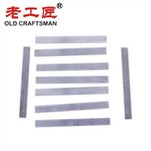
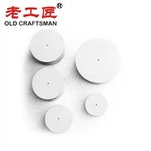
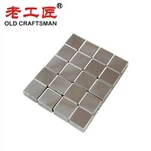
Cemented carbide products are made of tungsten carbide as the main raw material, and are made by a series of processes such as ball milling, mixing, drying, pressing, sintering, heat preservation, and cooling by powder metallurgy. It has high hardness, high bending strength, and high strength. Density, impact resistance, corrosion resistance and rust-resistant alloy materials are usually made into plates, sheets, discs, round bars, strips or molded into different special-shaped cemented carbides according to application requirements.
There are many reasons that affect the deformation and bending of cemented carbide products. It is necessary to analyze the specific conditions of cemented carbide products. It may be caused by one factor or a combination of multiple factors. The main reasons are: carbon gradient, cobalt gradient, temperature gradient, compacted product density gradient, improper boat loading, shrinkage coefficient, etc.
It is also possible that in the process of cemented carbide machining, the machining accuracy of the parts is changed due to the internal force.
In lathe processing, the centripetal force is usually used to clamp the parts with the three-jaw or four-jaw chuck of the lathe before processing. This is easy to cause the machining accuracy to change under the action of the force.
It is easier to deform after heat treatment. For sheet-like mechanical parts, due to its very large long diameter, it is easier to bend after heat treatment. There may be a bulging phenomenon in the middle, and the plane deviation will increase. On the other hand, due to the influence of various external factors, the parts will be bent.
There is also the elastic deformation caused by external force. There are several main reasons for the elastic deformation of parts when processing cemented carbide. One is that if the internal structure of some parts contains thin slices, it will have higher requirements for the operation method. Otherwise, when the operator locates and clamps the parts, it will not be able to correspond with the design of the drawing, which will easily lead to elastic deformation. The production. The second is the unevenness of the lathe and the fixture, which makes the parts receive uneven force on both sides of the fixing process, resulting in the part with the smaller force applied during cutting, which will cause translational movement and part deformation under the action of the force. The third is the unreasonable positioning of the parts during the machining process, which reduces the rigidity of the parts. Fourth, the existence of cutting force is also one of the reasons for the elastic deformation of parts.
These are the factors that cause bending and deformation of cemented carbide products. We must pay extra attention in the process of processing. Once deformed, the workpiece can only be scrapped. Not to mention the wasteful cost, the key is that it needs to be restocked, which delays the customer's delivery.