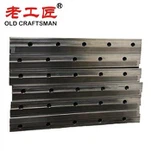
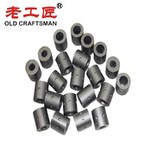
Next we are going to compare several wear plates or liners that are widely used in the market.
Wear-resistant ceramic rubber composite plate
There are two in one and three in one types of wear-resistant ceramic rubber composite panels. The two-in-one is glued and the three-in-one is welded and bolted. It is widely used in the anti-wear lining of various equipment and pipelines (such as blanking troughs, hoppers, etc.) in the temperature range of -40℃~100℃.
Features of wear-resistant ceramic rubber composite plate:
1. Impact resistance, alumina wear-resistant ceramic lining rubber has good buffering properties, which can effectively buffer the impact caused by ores falling from a high altitude, and the wear-resistant ceramic lining is because the main raw material of the product is alumina, it is wear-resistant. However, the toughness is insufficient. When the impact reaches a certain level, the wear-resistant ceramic rubber composite plate must be selected.
Second, the construction is convenient, and there is no gap after the lining plate is installed. The rubber composite lining can be twisted and cut, and is suitable for installing various special-shaped equipment.
3. No sticking and no blocking: Due to the high strength and corrosion resistance of ceramics, the phenomenon of equipment sticking and blocking is effectively solved.
Fourth, it has strong wear resistance, impact resistance and corrosion resistance. Rubber elastomer has excellent vibration damping effect, which can reduce the noise generated during material conveying.
5. The wear-resistant ceramic rubber composite plate has a lower density and lighter weight than steel plates, and because of its high wear resistance, it does not need to be replaced frequently, which saves a lot of costs for enterprises.
High Chromium Alloy Wear-Resistant Liners'Characteristics and Standards
High-chromium alloy wear-resistant lining generally refers to alloy white iron with a chromium content of 20% to 30% and a carbon content of 2.4% to 3.6%. Its distinctive feature is that the microhardness of M7C3 eutectic carbide is HV1300-1800, which is in the form of broken network, and is isolated and dispersed on the matrix of martensite (hard structure in the metal matrix), which reduces the splitting effect on the matrix. . Therefore, the high-chromium alloy liner has high strength, toughness and high wear resistance, and its performance represents the current level of metal wear-resistant materials. It has been widely used in large-scale cement ball mills abroad. The general service life (one warehouse) is 6 to 8 years, and the second and third warehouses are more than 12 years, showing good wear resistance.
In practical applications, low-carbon and high-chromium cast iron (steel) linings are generally used for working conditions with large impact loads; high-carbon high-chromium cast iron linings are used for working conditions with small impact loads, so as to give full play to the material. wear resistance. The grinding head plate can be made of medium (low) carbon and high chromium cast iron; the discharge grate plate can be made of medium, high carbon and high chromium cast iron; the partition plate composed of blocks can be made of low carbon and high chromium cast iron.
Wear-resistant composite steel plate features
1. High wear resistance
In the chemical composition of the alloy layer, the carbon content is 4~6%, the chromium content is as high as 25~30%, the volume fraction of Cr7C3 carbide in the metallographic structure is more than 45%, the macro hardness is HRC56~62, and the hardness of chromium carbide is HV1400~1800, higher than the hardness of quartz in sandstone HV800~1200. Since the carbides are distributed perpendicular to the wear direction, the wear resistance is more than doubled compared with the cast alloys of the same composition and hardness.
2. Good impact resistance
The bottom layer of the wear-resistant clad steel plate is low carbon steel or low alloy. Tough materials such as stainless steel reflect the superiority of bimetals, the wear-resistant layer resists the wear of the wear medium, and the substrate bears the load of the medium, so it has good impact resistance. It can withstand impact and wear such as high drop hoppers in material conveying systems.
3. Good heat resistance
The wear-resistant layer is recommended to be used under the working condition of ≤600℃. If vanadium, molybdenum and other alloys are added to the alloy layer, it can withstand high temperature wear of ≤800℃. The recommended operating temperature is as follows: Ordinary carbon steel substrates are recommended to be used under 380℃; Low alloy heat-resistant steel plates (15CrMo, 12Cr1MoV, etc.) are recommended to be used under 540℃; Use at 800 ℃.
4. The alloy layer of the good corrosion-resistant and wear-resistant composite steel plate contains a high percentage of metallic chromium, so it has certain rust and corrosion resistance. It can be used to prevent coal from sticking to coal drop drums and funnels.
5. Strong applicability
The wear-resistant composite steel plate has complete specifications and varieties, and has become a serialized product. The thickness of the wear-resistant alloy layer is 3~20mm. The minimum thickness of the composite steel plate is 6mm, and the thickness is not limited. At present, the standard wear-resistant composite steel plate can provide 1200 or 1450 × 2000mm, and can also be customized according to the size of the drawings according to the needs of users. Wear-resistant composite steel plate is divided into three types: ordinary type, impact-resistant type and high-temperature type. Ordering high-temperature wear-resistant and impact-resistant composite steel plate should be explained.
6. Convenient processing
The wear-resistant composite steel plate can be cut, leveled, punched, bent and curled, and it can be made into flat plates, arc plates, cone plates, and cylinders. The cut composite panels can be tailored and welded into various engineering structural parts or components. The composite board can also be heated and pressed into complex shapes with a mold. The wear-resistant composite steel plate can be fixed on the equipment with bolts or welding, which is convenient for replacement and maintenance.
7. High price performance ratio
Although the manufacturing cost of wear-resistant composite steel plate increases, the service life is increased several times, which greatly reduces maintenance costs and downtime losses. Its price performance is about 2 to 4 times higher than that of ordinary materials. The larger the material handling capacity, the more serious the wear and tear of the equipment, the more obvious the economic effect of using wear-resistant composite steel plate.
Carbide Welded Wear-resistant Liner Plates
It usually refers to cemented carbide inlaid or welded wear-resistant linings, that is, cemented carbide blocks are inlaid or welded on stainless steel and other substrates, so as to achieve the combination of maximum cost-effectiveness and high wear resistance.
Cemented carbide is superior to the above wear-resistant lining materials in terms of wear resistance, heat resistance, red hardness, impact resistance and corrosion resistance.
The main factors affecting the quality of welded cemented carbide wear-resistant liners:
1. The choice of grade of cemented carbide itself. Since the hardness and toughness of cemented carbide are inversely related, in order to adapt to the working conditions, it is necessary to not only ensure the hardness of the cemented carbide wear-resistant lining, but also need it to have a certain toughness to achieve the best performance of the cemented carbide wear-resistant lining. , so choosing the right grade is critical.
2. Another key factor is the bonding strength of the cemented carbide to the substrate (usually stainless steel). Practice has shown that the use of vacuum welding furnace can effectively control a series of quality factors, say brazing gaps, thereby effectively improving the bonding strength between the cemented carbide blocks and the base material.
ZZ Old Craftsman uses advanced vacuum welding furnace for the production of carbide welded wear plates. And we use a CNC machining center to process grooves, threads, countersinks, etc. on the steel base material, and then assemble and weld the steel base and cemented carbide blocks, which greatly facilitates installation and maintenance, improving the overall cost performance.


At present, the cemented carbide wear-resistant linings produced by our company include chute linings, hopper liners, refractory brick mold liner wear plates, hammers of sand crushers and impact blocks, with reasonable prices. Of course, our other cemented carbide welding products, such as cemented carbide welding scraper products, are also our advantageous products.
Moreover, we are very willing to accept the development and production of new products, and we have to say that we are very patient and confident in this regard.